Cuba
The Red Dot
Ana pauses a class count when a mark is hard to read.
Page 1 of 5
Ana’s class in Havana voted on which game to play. Their teacher tried a program to count the paper votes. The program chose one answer for every slip.
Page 2 of 5
Ana saw the screen give a point for cards that had messy marks. Had all those children meant the same thing?
Page 3 of 5
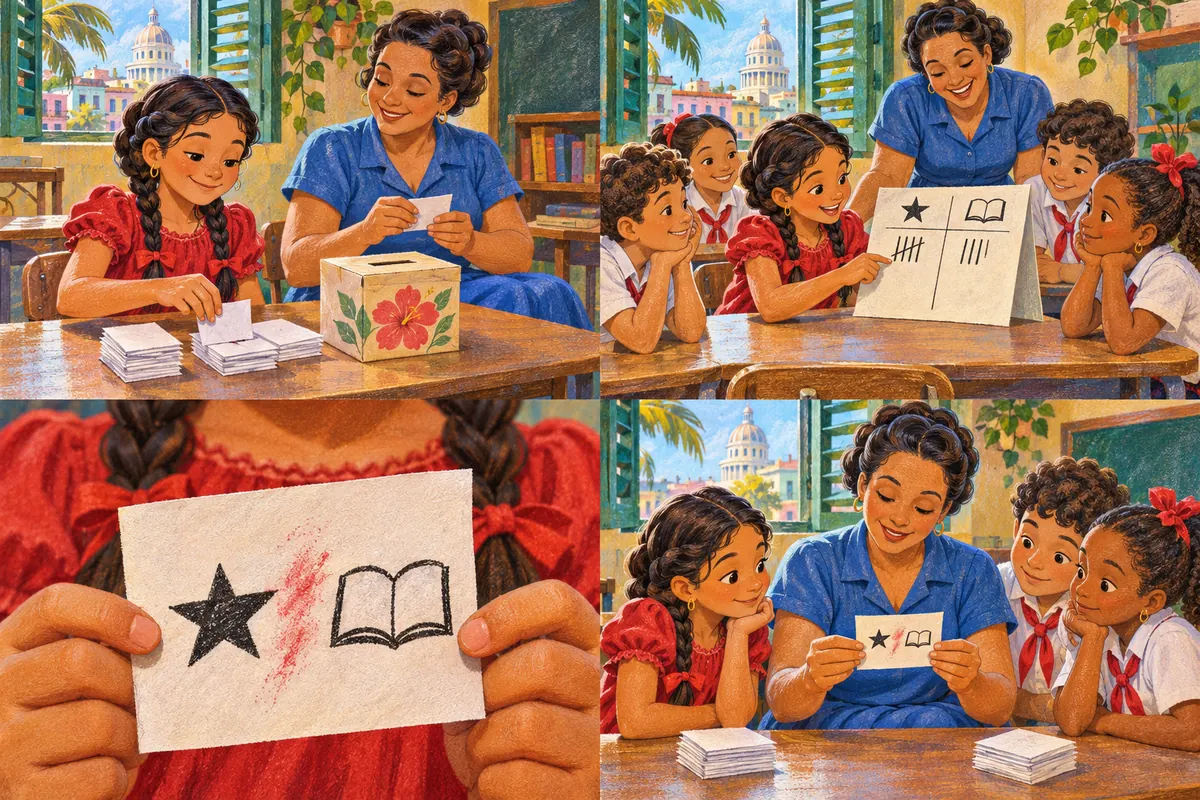
Two slips had dots right on a picture. On a third, a red mark sat between the two choices and could not be read clearly.
Pause and solve
Which slip should the class set aside to check?
Show a hint
Find the dot that is not clearly on a picture.
Reveal the answer
The one with the smudged mark between choices.
Page 4 of 5
The class used a rule they could all see: two student watchers checked doubtful marks with the teacher. They kept the unclear slip separate and counted it as unclear.
Page 5 of 5
Ana still hoped her game would win. She wanted the count to be fair even more.
The lesson
A computer’s guess should not settle a doubtful vote.
Talk about it
What makes a count fair for people who hoped for different results?
For parents and teachers
Before a group vote, agree how to record unclear choices and who can check the count.