Guadeloupe
Reef Days
Luc spots the difference between seeing more fish and counting for longer.
Page 1 of 5
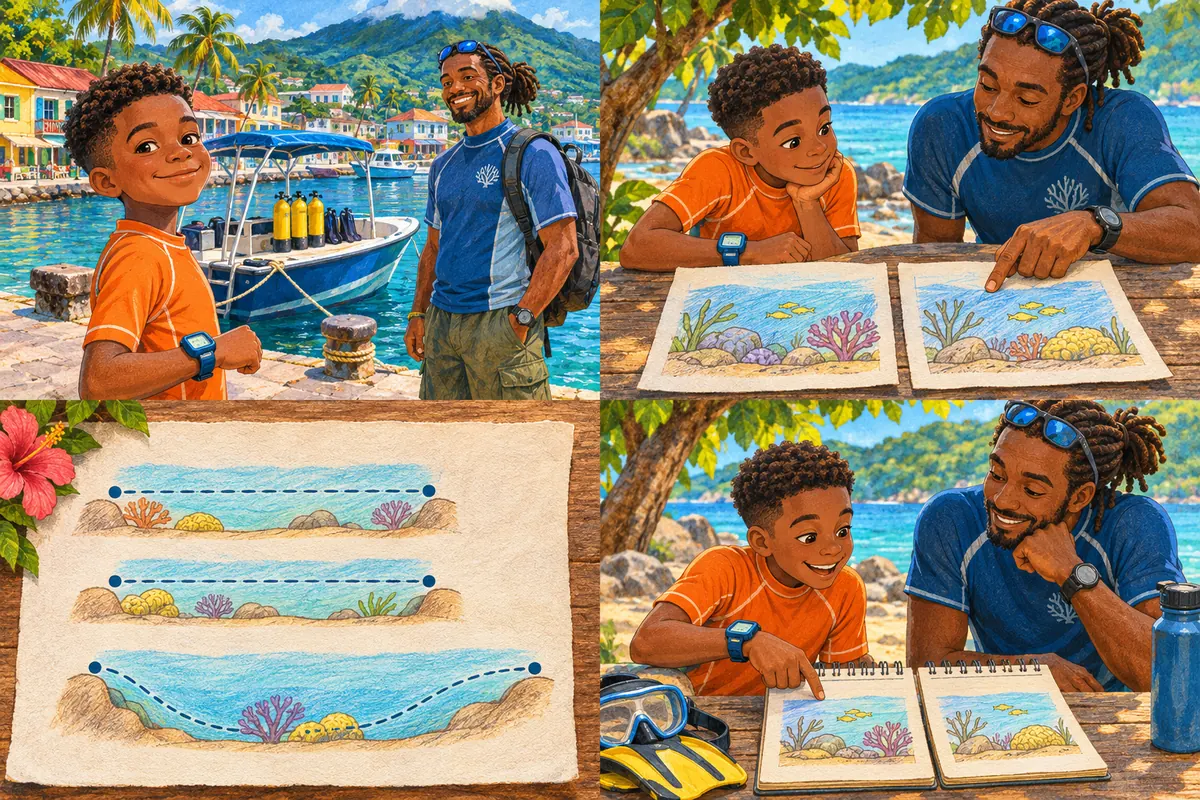
The little boat rocked in Basse-Terre harbour. Luc watched a guide wash a camera used to film fish at the reef. He wanted to know what it had seen.
Page 2 of 5
The guide opened a tool that used AI to count fish in the clips. “It found more today,” he said. Luc noticed that one dive had lasted longer than the others.
Page 3 of 5
Luc laid out three drawings of the paths the guide had swum. He pointed to the two that ran the same distance at the same depth. “What if we compare just those?”
Pause and solve
Which two dives are easiest to compare?
Show a hint
Look for a pair with the same length and the same depth.
Reveal the answer
The two with the same distance and depth.
Page 4 of 5
Back on shore, the guide opened the two sets of clips from the matched dives. He watched some of the fish pass twice and corrected the count himself.
Page 5 of 5
They still needed more trips to know if fish numbers had changed. Luc helped draw the route for the next visit. He added a mark where the guide should start counting.
The lesson
To spot a change in nature, try to count the same way each time. Check a tool's counts against what you can see.
Talk about it
What else might change how many fish a camera can see?
For parents and teachers
Count birds from one spot for five minutes on two days. Discuss how changing the spot or the time would change the comparison.