 Caribbean AI Association
Jamaica: job, AI an export demand
Di study start wid Jamaica job figure fi July 2026 an compare possible outcome up to January 2030. Di result depend pon how productivity change, how worker move between job an how much service overseas buyer waan.
Caribbean AI Association, 20 October 2026. Version 2.0. Descriptive evidence, conditional economic simulation an deterministic demand stress test. No journal peer review. Translation of di 20 November 2026 print edition.
Job, industry an export demand
AI inna Jamaica depend pon wah change inside firm an pon demand fi di service dem sell. Di study cover 32 occupation including bank teller, accountant, bookkeeper, lawyer, hotel staff, tour guide an musician. Di official July 2026 employment figure form di base fi five economic scenario an four weak export-demand case. None carry a probability. [S01–S03, S08–S10, S13]
Di extreme outsourcing test take weh every contract fi di activity weh di model cover. Output an demand fi labour inna dat activity fall to zero. Other business can expand an worker can find other job. It cyan forecast Jamaica global service sector, national unemployment or permanent job loss. CAIA adapt di Anthropic task framework wid official job figure, simulation an industry demand stress. Anthropic never review or endorse dis adaptation. [S01–S03]
Scenario · 2030 GDP level gap · unemployment. Di first five row compare di core economic model wid a no-AI path weh share di other condition dem. Di last four compare AI plus lost demand wid a path wid no AI an no shock. GDP difference measure output level, not annual growth rate.
Gradual adoption — +0.71% · 3.40%
Widespread adoption — +3.61% · 3.76%
Rapid automation — +13.50% · 8.07%
Worker-led adoption — +2.56% · 3.60%
Digital service upgrade — +4.94% · 3.81%
Outsourcing contract dem shrink — +2.06% · no estimate
Nearshore outsourcing collapse — +0.50% · no estimate
Tourism demand shock — +1.54% · no estimate
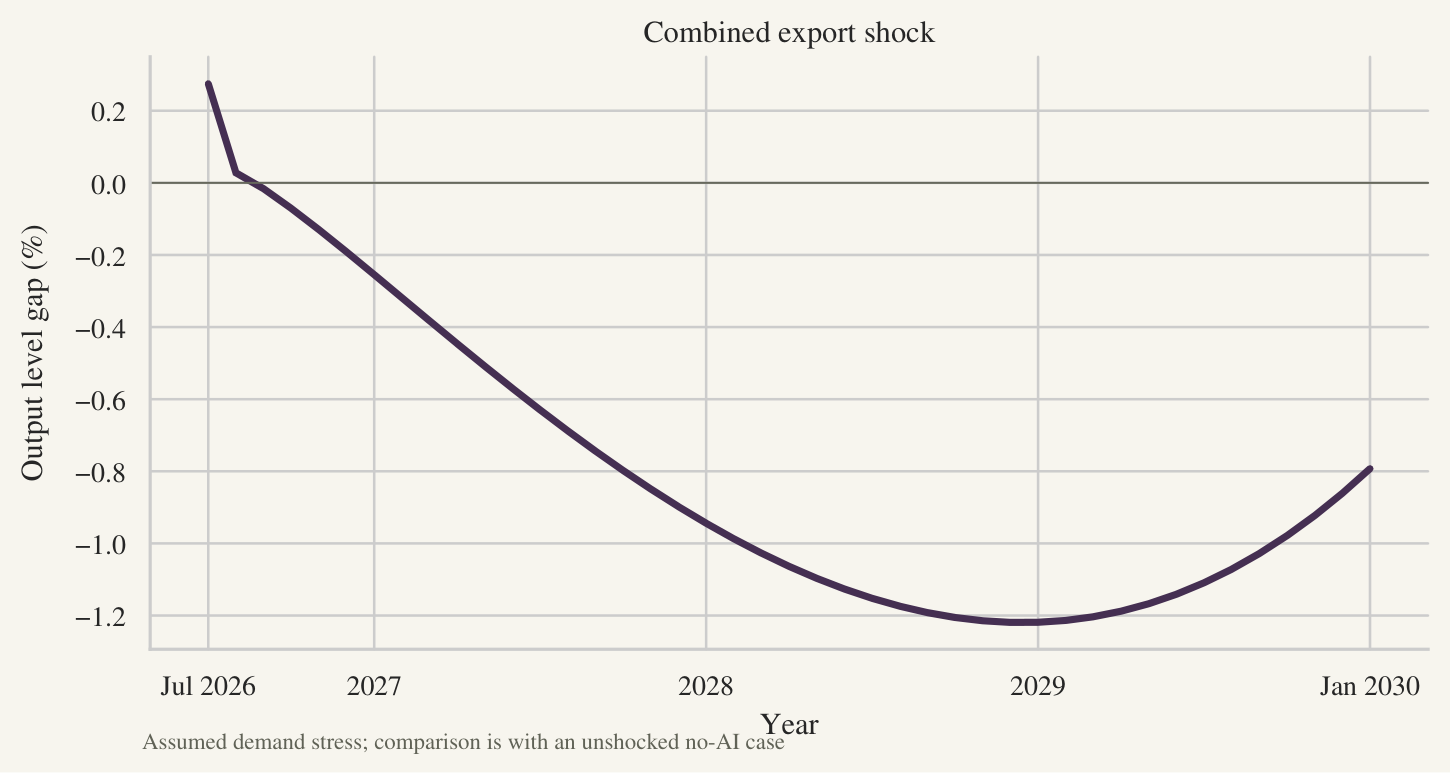
Combined export shock — -0.79% · no estimate
Approach an core finding
Inna di broad case, 2030 output stand 3.61% above di matched path while cognitive wage drop 1.97% an unemployment reach 3.76%. Firm an government need fi assess productivity alongside pay, job change an support fi people moving job. Di study ask how capability, adoption an autonomy interact wid Jamaica workforce an di difficulty of switching occupation. It look at output, wage, factor share an unemployment at di start a 2030. Descriptive data an conditional simulation cyan identify AI causal effect pon job. Di technical report supply di framework; dis paper document di adaptation an limit. [S01–S02]
Official job an economic data
Di revised STATIN July 2026 Labour Force Survey estimate 1,419,200 employed an 1,468,500 inna di labour force, including 49,300 unemployed. Di rate work out to 3.357%, rounded to di published 3.4%. Informal employment cover 797,400 people or about 56.2%. Di current STATIN explorer supply di baseline. Di downloadable workbook end July 2025 an only serve fi historical comparison. STATIN may revise di observation dem after di study date. [S03–S04]
Industry · employed people inna July 2026 · share of official total. Table keep di original number format.
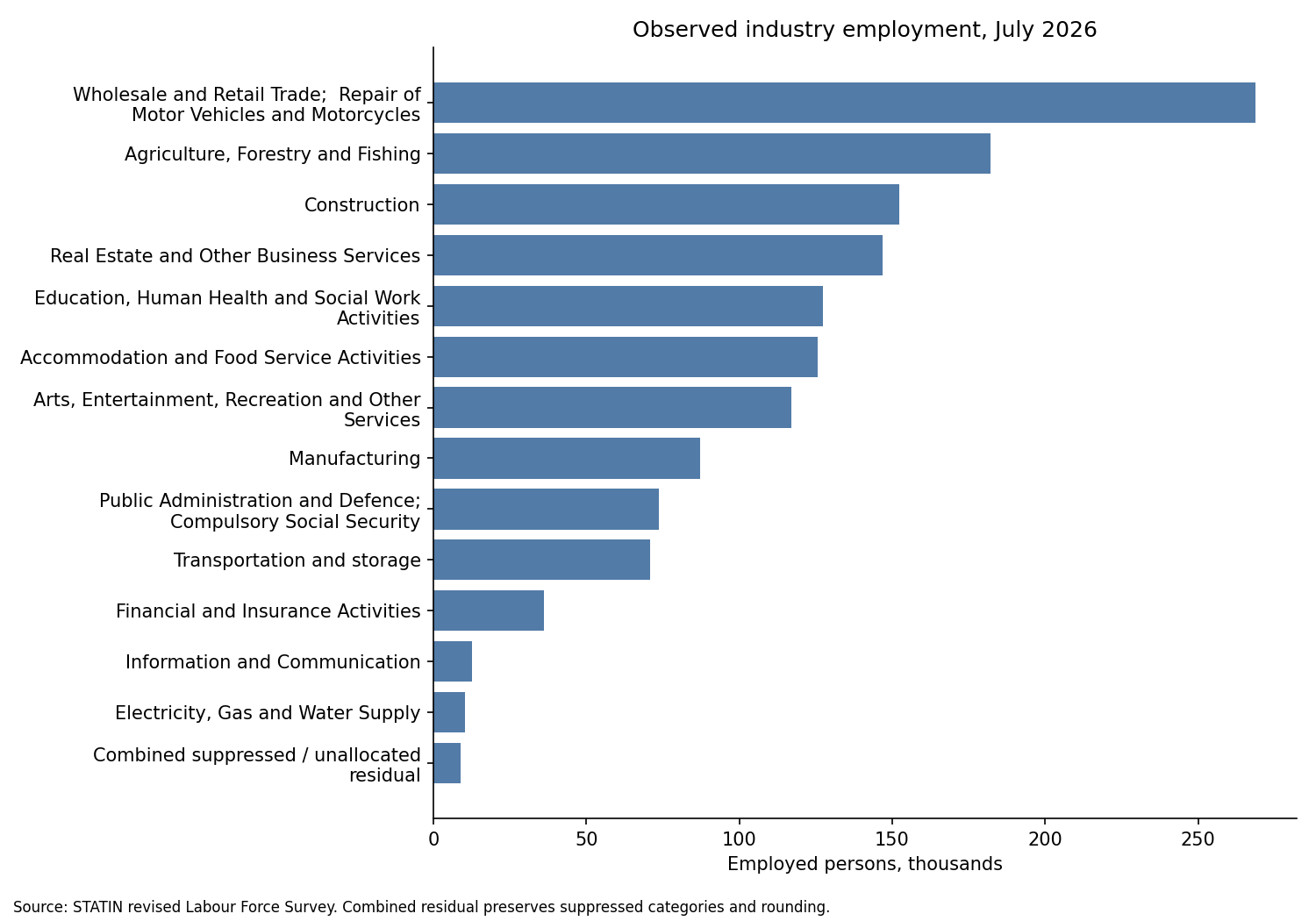
Farming, forestry an fishing — 182,200 · 12.84%
Manufacturing — 87,100 · 6.14%
Light, gas an water supply — 10,400 · 0.73%
Construction — 152,200 · 10.72%
Wholesale an retail, motor vehicle an bike repair — 268,700 · 18.93%
Transport an storage — 70,700 · 4.98%
Accommodation an food service — 125,500 · 8.84%
Information an communication — 12,500 · 0.88%
Finance an insurance — 36,100 · 2.54%
Real estate an other business service — 146,800 · 10.34%
Public administration, defence an compulsory social security — 73,800 · 5.20%
Education, health an social work — 127,300 · 8.97%
Arts, entertainment, recreation an other service — 117,100 · 8.25%
Combined suppressed or unallocated remainder — 8,800 · 0.62%
STATIN suppress mining an unspecified industry counts. Di published industry total fall 8,800 short of official employment. Wi keep di difference as a combined residual fi suppressed, unallocated or rounded employment; it cyan serve as a mining count. Trade employ di most among di reported sector. Agriculture, construction, business service, education an health, accommodation an food an other service have sizeable workforce too. Size show potential reach, not exposure. Hotel reception, cooking, cleaning, maintenance an management involve different task. [S03]
Manager, professional, technician an clerical staff add up to 461,500, or 32.52%. Service an sales employ another 333,000. Assuming one quarter of dem do cognitive work put di central cognitive share at 38.38%. A study assumption dis, not a STATIN estimate. Wi test di fraction from zero to one an leave unclassified work outside di central cognitive group. Occupation count add to 100 more dan official employment. Wi treat dat as rounding, keep di source counts an use di official total as denominator. Di data keep male an female observation an history from January 2024. Education an formal employment cyan stand in fi measured AI literacy. [S03]
Occupation group · employed inna July 2026.
Manager — 112,300
Professional worker — 125,900
Technician an associate professional — 98,400
Clerical support worker — 124,900
Service an sales worker — 333,000
Skilled farming, forestry an fishing worker — 174,800
Craft worker an related trade — 178,900
Plant an machine operator an assembler — 77,000
Elementary occupation — 187,500
Occupation weh nuh fit elsewhere — 6,600
Total people weh employed — 1,419,200
Economic model an Jamaica calibration
Production bundle task together. Automation, assistance an new task change capital demand an movement between cognitive an other occupation. Di monthly system use Alan Lujan MIT-licensed Econ-ARK implementation. It never fit as a Jamaican forecast. [S01 Sections 2–3, Appendix A; S14]
From mid-2026 to di start a 2030, Jamaican workforce composition an unemployment replace di US baseline. Di initial affected mass an di capability path scale by Jamaica cognitive share relative to di US share inna di original framework. Assumed adoption start at 5% of affected task instance an finish at 15%, 30% or 50% inna di original three case. Dem path never come from a Jamaica survey.
Central setting: CES substitution elasticity 0.5, capital-supply elasticity 3, labour share 0.6, annual separation fraction 0.11, wage rigidity 0.5 an cross-group mobility 0.17. Common separation hazard replace di US relative occupation hazard. Di framework or author set dem value, widout estimation from Jamaican worker flow. Wi test dem sensitivity. Di 2023 account show employee compensation J$1,484,084 million an GDP J$3,301,898 million. Subtract tax less subsidy fi get gross value added, but compensation leave out labour from mixed income. Di ratio cyan measure all labour income, so 0.6 remain assumed. [S05–S06]
Mek m mean affected labour-task mass, d diffusion across instance, a log productivity gain, ψ automation share, ρ new labour-task mass per unit automated an σ CES elasticity. Di displacement term a z = m d [1 − ρψ − (1 − ψ) exp(−(1 − σ)a)]. It change labour demand while wage an capital adjust; it cyan count dismissal. Di matching block combine search pool, vacancy an mobility an update employment an unemployment monthly wid labour force fixed. Di original inventory have 42 example of possible oversight work. Dem nuh set ρ or prove new job creation; dat need local evidence. [S01, S14]
Each no-AI comparison keep di same non-AI mobility condition, cause mobility alone can change unemployment. Paired log path difference fi output an wage convert to percentage. Difference between final unemployment rate times fixed labour force give extra people unemployed at di end, not layoff added up. Di no-AI path assume 1% annual labour-augmenting growth wid no labour-force growth. Output gap relative to dat path nuh forecast nominal GDP. Migration, participation an lower birth rate can change labour supply outside dis model.
2030 input · gradual · broad · rapid automation.
Affected labour-task mass — 12.31% · 18.47% · 30.78%
Adoption among affected task instance — 15% · 30% · 50%
Autonomous share — 50% · 75% · 90%
New task mass per automated mass — 0.50 · 0.25 · 0.00
Cross-group mobility parameter — 0.17 · 0.08 · 0.04
Scenario result
Capability, adoption, autonomy, new task an mobility change together. Rapid automation assume weaker movement between occupation an no reinstatement of cognitive task mass. Di difference cyan be put down to adoption alone. No probability assigned. One-factor sensitivity come separately.
2030 result · gradual · broad · rapid automation.
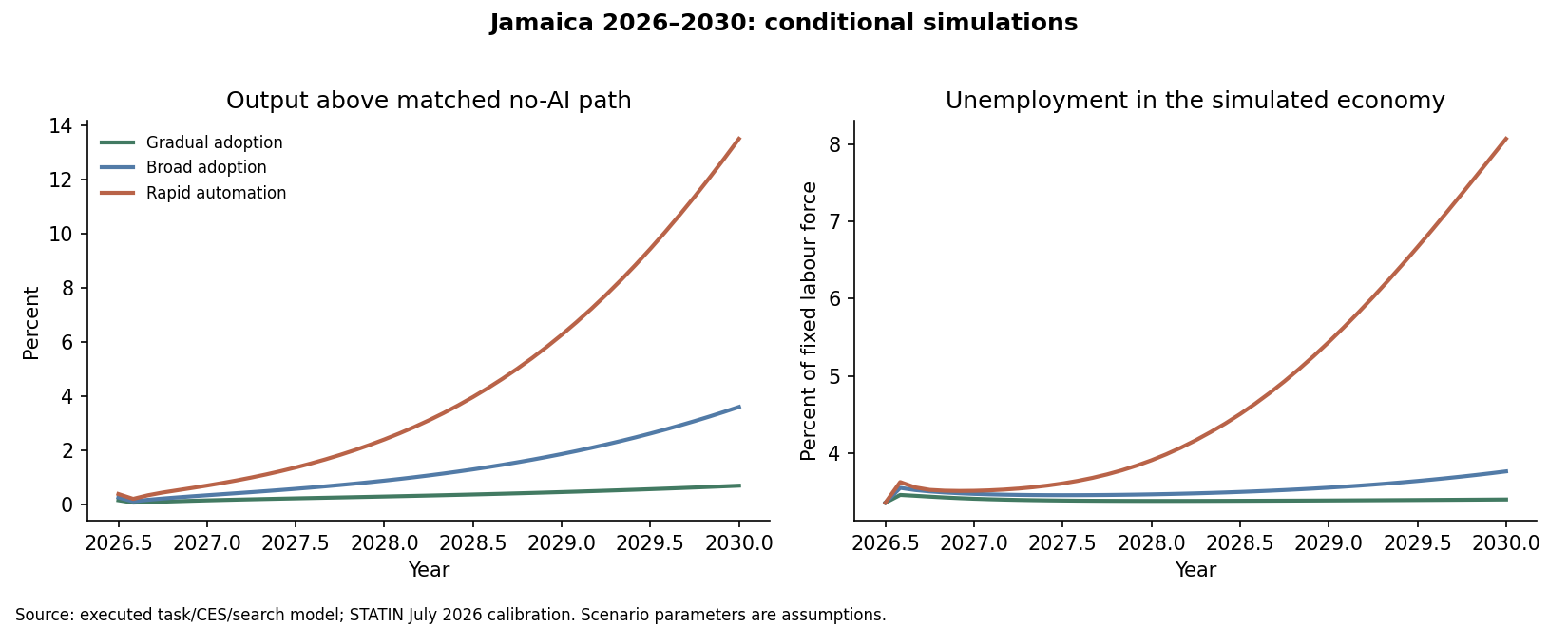
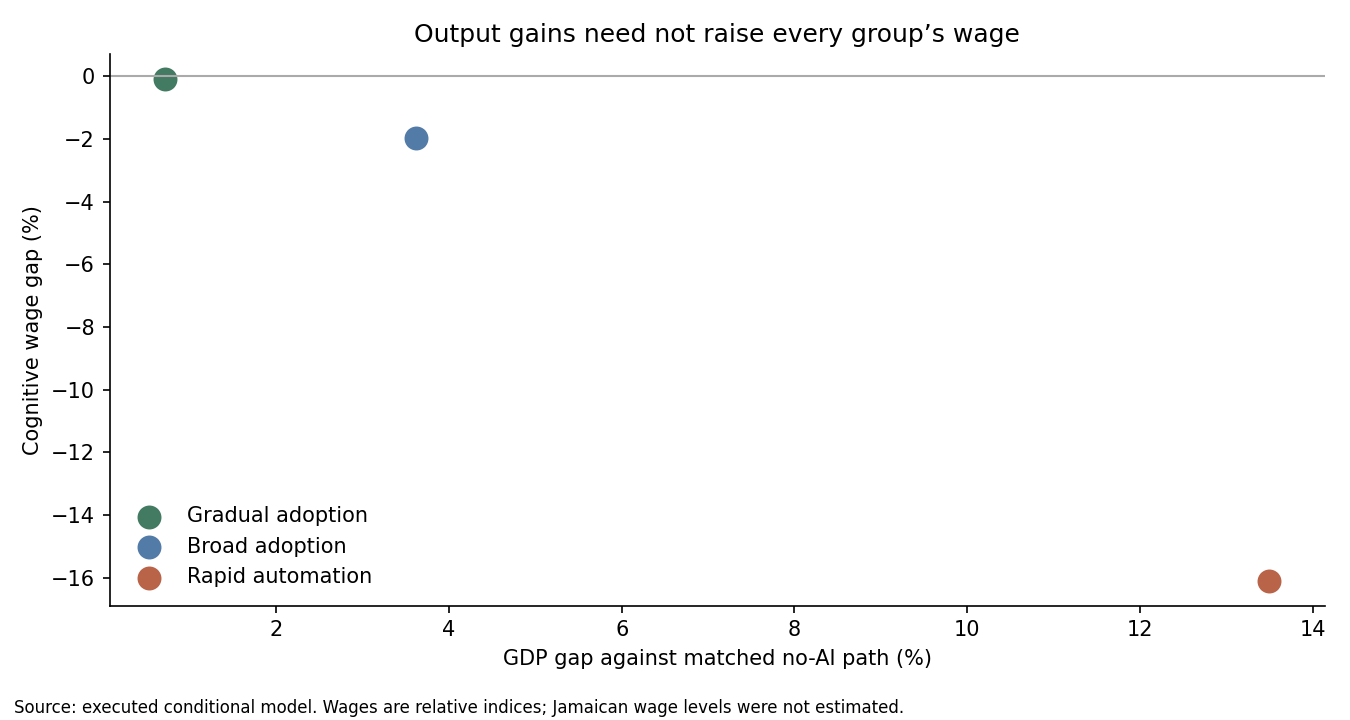
GDP gap against matched path widout AI — +0.71% · +3.61% · +13.50%
Unemployment — 3.40% · 3.76% · 8.07%
Matched unemployment widout AI — 3.36% · 3.40% · 3.39%
Extra unemployed people at di end — 595 · 5,328 · 68,700
Cognitive group wage gap — -0.08% · -1.97% · -16.10%
Other group wage gap — +0.57% · +2.86% · +15.38%
Labour share wid assumed 60% start — 59.73% · 58.22% · 52.73%
Wah di result imply
Gradual adoption give 0.71% more output an about 595 more unemployed at di end. Cognitive wage edge down an other wage edge up. Uncertainty bout task definition an adoption matter fi small difference. Two decimal place record di calculation, not forecast precision. Broad adoption give 3.61% more GDP an unemployment 3.76% versus 3.40%, about 5,328 additional people. Cognitive wage down 1.97% an other wage up 2.86% against dem own comparison. Gains uneven.
Rapid automation raise output 13.50%, unemployment 8.07% against 3.39%, about 68,700 extra unemployed an cognitive wage 16.10% lower. Strong assumption bout automation an adjustment nuh predict 68,700 dismissal. Policy need fi address distribution an movement. Helping people use AI inna di current job differ from helping dem reach a new occupation. GDP cyan settle household welfare, fiscal redistribution, payment fi imported AI, foreign ownership or environmental cost weh di model leave out.
Task an industry workload
Di v1 screen contain 475 O*NET statement fi 21 representative occupation inna agriculture, manufacturing, utility, construction, retail, freight, trucking, hospitality, software, accounting, insurance claim, customer service, data entry, public administration, teaching, nursing, design an mining. US description structure di local assessment. No verified one-to-one Jamaica crosswalk or Jamaican occupation headcount assigned. [S08, S10]
Di provisional rule tag 135 task human-led, 318 candidate fi assistance an 22 fi automation. Dem count nuh measure working time. Physical delivery, care, teaching an supervision cue take priority. Routine record an transaction cue mark candidate fi automation; di rest default to augmentation review. Rule, reason an task ID provided. Inna nursing, direct care an drawing blood stay human-led while record an planning can get help. Qualified staff keep clinical judgement an sign-off. Bookkeeping an data entry still need exception handling an reconciliation; customer service need separate routine an complex judgement assessment. Dem a hypothesis, not local validation. [S08–S09]
Separate industry an occupation table nuh show which occupation work inna each industry. All business service cyan count as BPO, nor all education an health as teacher an nurse. Dat need joint counts an task time. Di editable calculator answer a narrower question. Gross capacity = worker × adoption × [automatable share + augmentable share × (1 − 1/speedup)]. Multiply by realisation factor fi realised capacity. Share, speedup an factor a operational assumption weh nuh feed di macro model. Capacity measure time inna full-time equivalent unit. Time can serve more customer, cut queue or overtime, improve quality, expand service or cover vacancy. Checking, fixing error an integration can use up saving. Staffing decision need measured task time an quality.
One-factor sensitivity
Change one assumption at a time around di broad case. Range describe inputs tested, not probability or statistical interval. Joint change come later.
Driver · test value · GDP gap range · unemployment range.
Cognitive fraction inna service an sales — 0, 0.25, 0.5, 1 · 3.04% – 5.41% · 3.70% – 3.88%
Capital elasticity — 1, 3, 6 · 2.83% – 3.92% · 3.74% – 3.77%
Labour share — 0.5, 0.6, 0.7 · 3.46% – 3.72% · 3.75% – 3.77%
Wage rigidity — 0.25, 0.5, 0.9 · 3.26% – 3.81% · 3.55% – 4.13%
Adoption inna 2030 — 0.15, 0.3, 0.5 · 1.91% – 5.82% · 3.46% – 4.30%
Mobility between group — 0.04, 0.08, 0.17 · 3.43% – 3.75% · 3.58% – 3.96%
Annual job separation fraction — 0.06, 0.11, 0.18 · 3.57% – 3.73% · 3.61% – 3.84%
Changing di service/sales cognitive fraction move GDP gap from 3.04% to 5.41%. Moving adoption from 15% to 50% move di gap from 1.91% to 5.82% an unemployment from 3.46% to 4.30%. Adoption measurement an occupation mapping matter. Raising mobility from 0.04 to 0.17 reduce unemployment from 3.96% to 3.58%. Dat parameter nuh measure re-employment time or course completion. Slow wage adjustment raise transition unemployment too. Measure actual placement an job change; neither result prove a course change di parameter.
Demand, mobility an external condition
Di ministry report more dan 50,000 global digital service worker. Its view dat AI will change work a policy position, not causal evidence. Foreign client can buy more after cost drop, automate in-house, move supplier or cut contract. [S13] Di BPO stress use a labour index. Wid productivity multiplier 1.3, index = 100 × 1.3^(demand elasticity − 1) × (1 − external contract loss). Test elasticity 0.5, 1, 1.5 an contract loss 0%, 10%, 25%. Below one, labour demand can fall while output per worker rise; above one it can expand. Assume full cost pass-through, constant hours an no wage or capital feedback. Nuh add di index to national unemployment.
Another test apply hypothetical 2% an 5% output haircut multiplicatively to each AI outcome. External shock can offset technology gain. It nuh estimate hurricane damage, tourism fall or disaster probability. IMF post-Melissa release give recovery an external financing context; its fiscal-year projection nuh replace di calendar comparison. [S12] GDP measure domestic production. National an household income depend pon tax, remittance, wage an profit flow too. Imported AI can raise output an move part a di return overseas. Model use one capital good an no balance-of-payments block. Capital income nuh equal household income retained. Public 2007 input-output table give historical context only. Structure change; present-day multiplier need updated supply-use, value-added an trade account. [S05, S07]
Recommendation an delivery plan
Run workplace trial before expanding adoption. Include small an informal firm alongside administration, finance, insurance, global service an retail. Measure time, error, rework, quality, customer outcome an checking cost before an after. Use random rollout or credible comparison where practical. Time saved count as productivity only if di work meet standard. Ask STATIN fi joint job an industry counts wid at least two-digit occupation an JIC industry code, split by sex, age, education, parish an formality where sample allow. Request standard error, suppression rule, main-job definition an comparability note. Access subject to STATIN condition.
Support worker before staffing decision. Link transferable skill wid actual vacancy. Proposed follow-up at three an six month track placement, earning, retention an occupation switch; finishing a course nuh prove placement. Track non-confidential outsourcing renewal, work type, client location, seat use, output per worker an client AI requirement. Judge training fi complex service, checking, workflow management an analysis by paid job an retained contract, widout promising demand. [S13, S18–S19]
Small firm might need reliable connectivity, usable record, affordable access an training tied to dem own process. Shared implementation help could address dat. World Bank diagnostic identify infrastructure, skill, firm maturity an trust. Broadband alone nuh prove AI literacy; no national readiness score here. [S11] Public agency need clear decision owner. Start wid documentation, scheduling, retrieval an admin help. Before delegating further test accuracy, exception handling, monitoring an sign-off. Clinical, benefits, enforcement an credit decision need dem own assessment. Output gain cyaan establish suitability.
First 30 day: research lead an employer partner confirm source an request, choose pilot, log baseline task, definition, source register, timing an quality. Day 31–60: operations lead an worker representative run controlled workflow, check options an record error, comparable outcome an transition plan. Day 61–90: research lead an external economic reviewer re-estimate weight an adoption, update scenario, produce reproducible update an held-out pilot outcome. Quarterly after dat, policy an industry working group review earning, contract an job movement wid current placement an retention observation.
Assumption an limit
Missing local input include joint occupation-industry employment, task time, AI adoption an job movement. Di model use broad group an fixed labour force. It leave out firm entry, selective migration, ageing, participation, wage bargaining, formal-informal move, remittance, contract location, foreign ownership, fiscal redistribution an physical recovery. Demand stress cover only part. No Jamaican rating study validate di tag. Defaulting unclassified task to assistance mean dem count cyaan measure validated exposure. Expert rating, time-use data an detailed crosswalk needed fi use di ILO framework. Wi nuh apply global exposure percentage to Jamaican job. [S09–S10]
Dem simulation a neither forecast nor causal estimate. Di study never measure local task time, adoption or worker transition. Range nuh mean confidence interval. Timing a proposal. No evidence fi national programme cost, tax revenue or ROI claim. AI help wid research, code an drafting; CAIA retain publication responsibility.
Further scenario an joint uncertainty
Worker-led case assume 35% adoption, 45% autonomy, new-task parameter 0.65 an mobility 0.17. Digital upgrade use 45%, 65%, 0.45 an 0.17 respectively. Both use broad-case affected mass an productivity path set inna model. Dem combination nuh estimate effect of one training or industrial policy. New-task parameter measure task mass, not job.
Case · GDP level gap · unemployment · cognitive wage gap · other wage gap.
Gradual adoption — +0.71% · 3.40% · -0.08% · +0.57%
Widespread adoption — +3.61% · 3.76% · -1.97% · +2.86%
Rapid automation — +13.50% · 8.07% · -16.10% · +15.38%
Worker-led adoption — +2.56% · 3.60% · +0.88% · +2.91%
Digital service upgrade — +4.94% · 3.81% · +0.54% · +4.70%
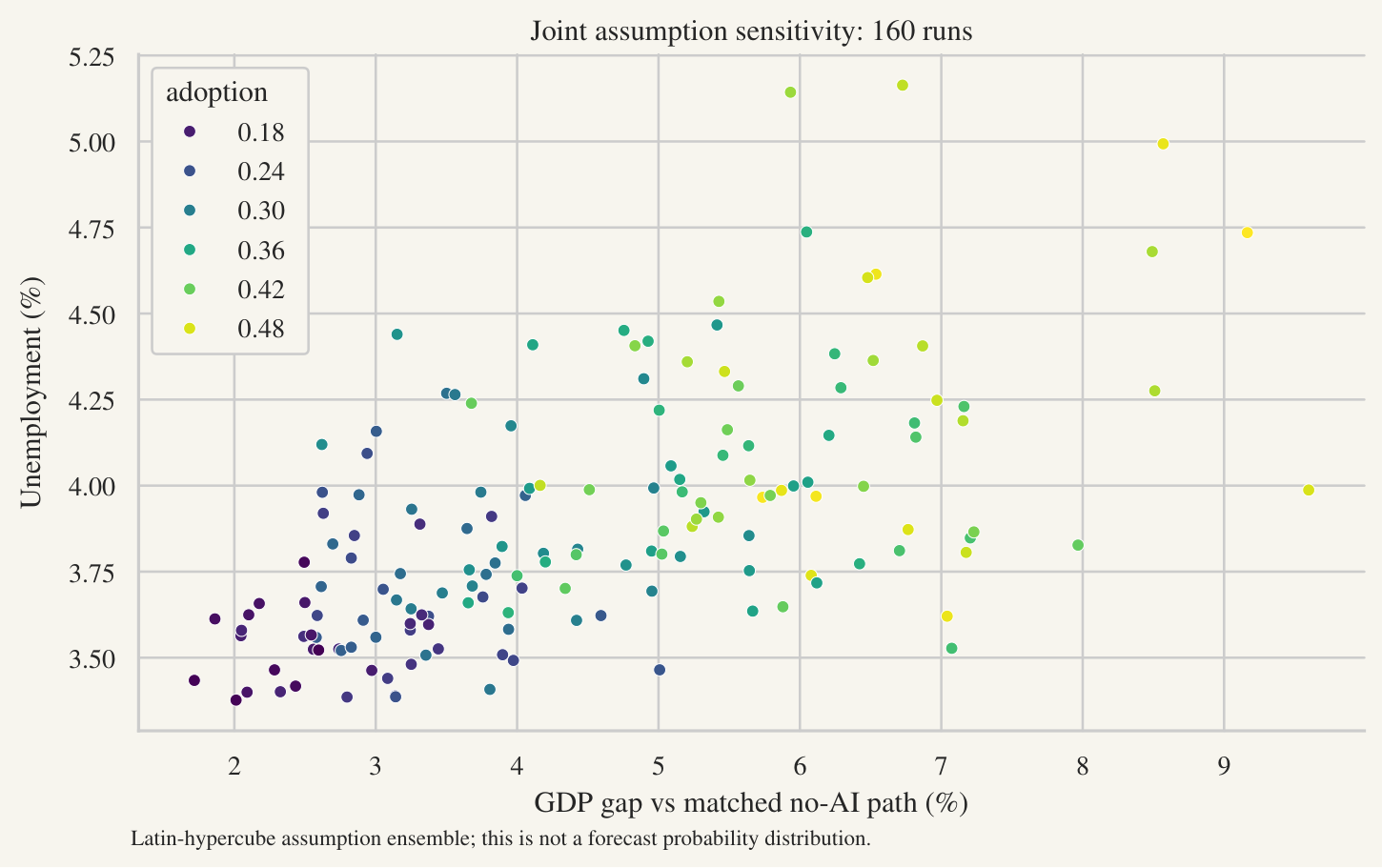
Joint sensitivity draw 160 Latin-hypercube setting wid fixed seed 20261020. Range: service/sales cognitive fraction 0–1, adoption 15–50%, mobility 0.04–0.17, wage rigidity 0.25–0.90, capital supply elasticity 1–6, initial labour share 0.50–0.70 an annual separation 0.06–0.18. Each draw get a matched no-AI run. Capability mass rescale wid alternative cognitive allocation. Illustrative 1% labour-augmenting trend stay consistent wid chosen labour share. Uniform sampling nuh mean equal economic likelihood. Across broad-case combination, final GDP gap run 1.72% to 9.60% an unemployment 3.38% to 5.16%. Other capability, autonomy or new-task input can land outside; dem nuh give statistical interval or all plausible outcome.
Outsourcing, nearshoring an tourism demand
Jamaican provider can raise productivity an lose contract if overseas client automate in-house, buy less or switch supplier. Dat different from task time saved locally. Di ministry March 2026 account report more dan 50,000 global digital service worker an a shift to more complex service. Its policy assessment support demand testing widout guaranteeing growth. [S13]
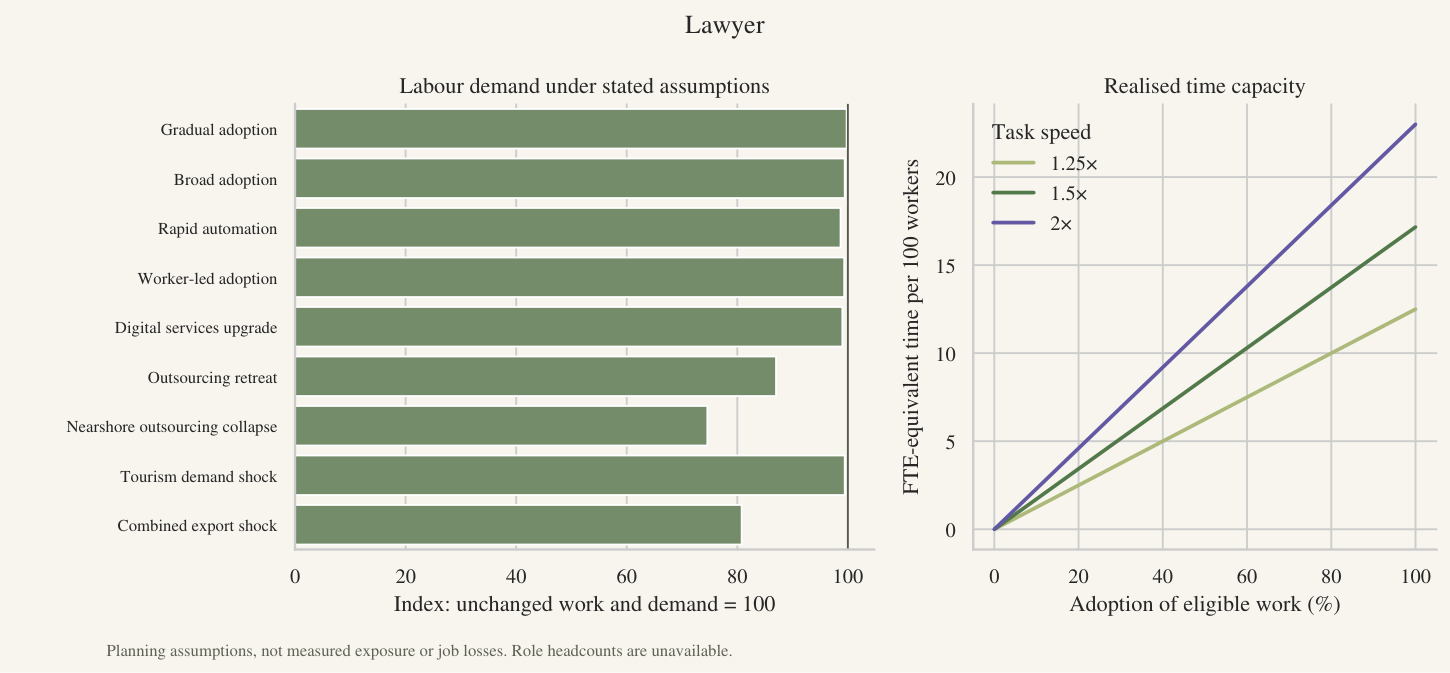
Mek P stand fi labour productivity multiplier, c fi external contract loss fraction, e fi exposed share of role demand, η fi demand elasticity under full cost pass-through. Output demand Q = 100(1 − ec)P^η. Labour demand N = Q/P = 100(1 − ec)P^(η−1). Both start at 100 when work an demand unchanged. Price, hours, quality an wage-setting simplified. If η < 1, labour need can fall even when output rise. If c = e = 1, both index exactly zero.
Di index cyan count dismissal. It leave out recruitment, hour change, vacancy, worker move, firm entry, wage response an foreign-demand feedback. Complete loss only apply to di named activity. Not everybody inna business service, ICT, accounting or law depend pon dem contract. Di 146,800 people inna broad business service nuh count as BPO employment.
Case · outsourced-service contract loss · tourism demand loss · recorded-music demand loss.
Outsourcing contract dem shrink — 50% · 0% · 0%
Nearshore outsourcing collapse — 100% · 0% · 0%
Tourism demand shock — 0% · 25% · 0%
Combined export shock — 75% · 25% · 30%
Fi scale alone use 50,000 as a conservative anchor fi di ministry “more than 50,000”. A 50% demand loss at fixed productivity leave 25,000 contract-supported position; complete withdrawal leave zero. Dem arithmetic example nuh current headcount, layoff forecast or extra national unemployment. Index preferable cause exact sector count, job mix an overlap wid AI displacement unknown. [S13]
Separate national diagnostic apply Y_stress/Y_noAI = (Y_core/Y_noAI)[1 − b c_B − t c_T]. Assumed value-added weight b = 0.03 fi outsourcing an t = 0.08 fi direct tourism; not measured Jamaica GDP share. Central net-demand multiplier one. Loss rise linearly from zero inna July 2026 to January 2030 setting. Dis deterministic output wedge nuh calibrated multi-sector equilibrium or current input-output multiplier. It nuh solve imported-input leakage, substitution or re-employment output, an nuh estimate national unemployment, wage or labour share.
BOJ balance-of-payments portal as inspected nuh supply a current BPO-only value-added series fi estimate di 3% an 8% weights. Gross export receipt need conversion to domestic value added; 2007 table too old. [S05, S07, S21] Combined case put di 75% outsourcing an 25% tourism loss inna GDP; recorded music only affect di musician example. Hotel an restaurant job nuh cover every job supported by tourism. Fewer visitor can affect transport, food supplier an entertainment too, widout data fi quantify di link.
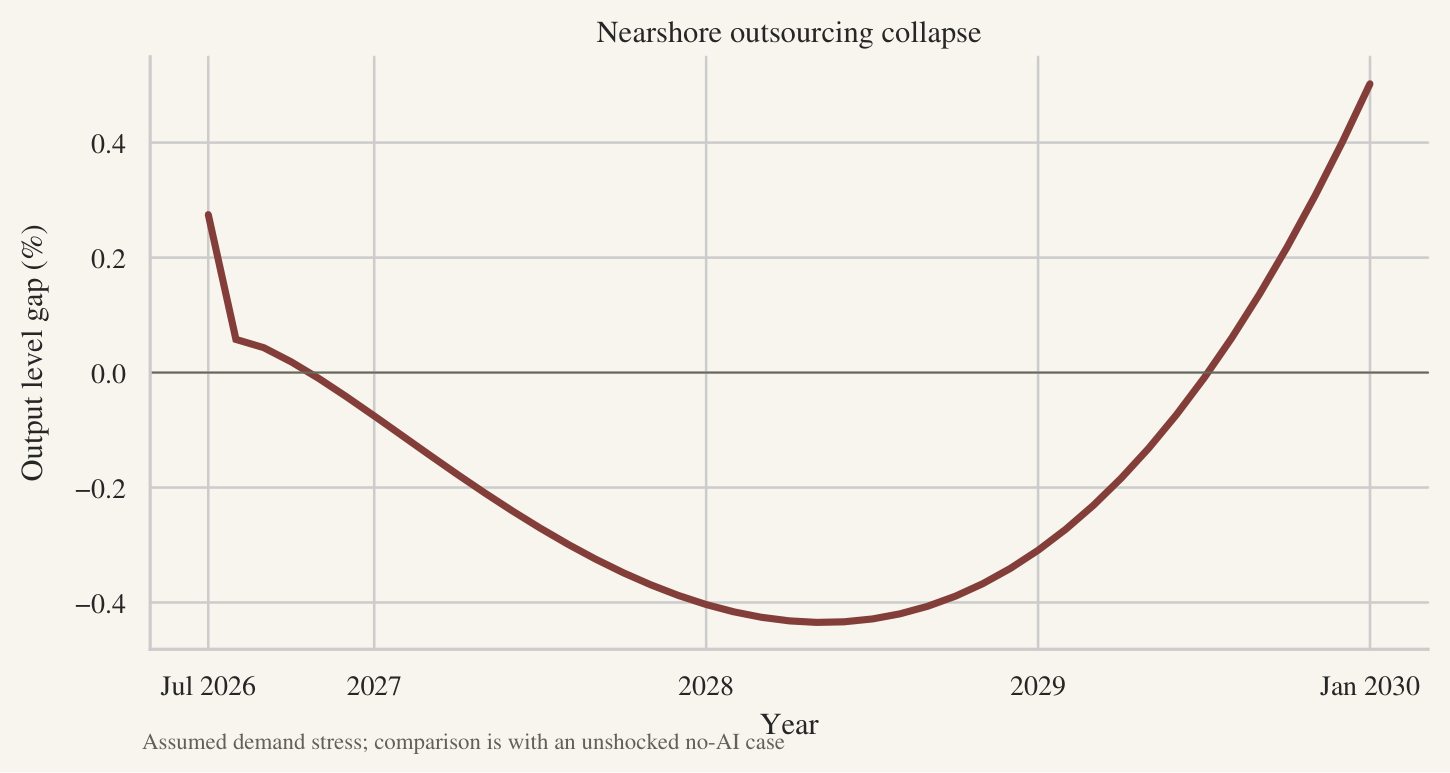
Sensitivity to export weight
Another 108 stress calculation vary outsourcing value-added weight from 1.5% to 5%, tourism weight from 5% to 12% an net-demand multiplier from 0.5 to 1.5. Broad assumption reveal dependence pon missing trade data. Multiplier a sensitivity input, not an estimated Keynesian or input-output multiplier. Range nuh probability interval.
Demand stress · GDP gap range over assumed weight.
Outsourcing contract dem shrink — -0.27% – +3.22%
Nearshore outsourcing collapse — -4.16% – +2.83%
Tourism demand shock — -1.05% – +2.96%
Combined export shock — -6.88% – +2.38%
Occupation catalogue an time calculation
Expanded catalogue contain 711 O*NET task record fi 32 representative occupation. US Department of Labor supply code an description, not Jamaican headcount, local task time, AI capability rating or adoption. Linking a role to industry show where work might happen, not how many do it. Earlier 475-record screen stay separate. [S08, S10]
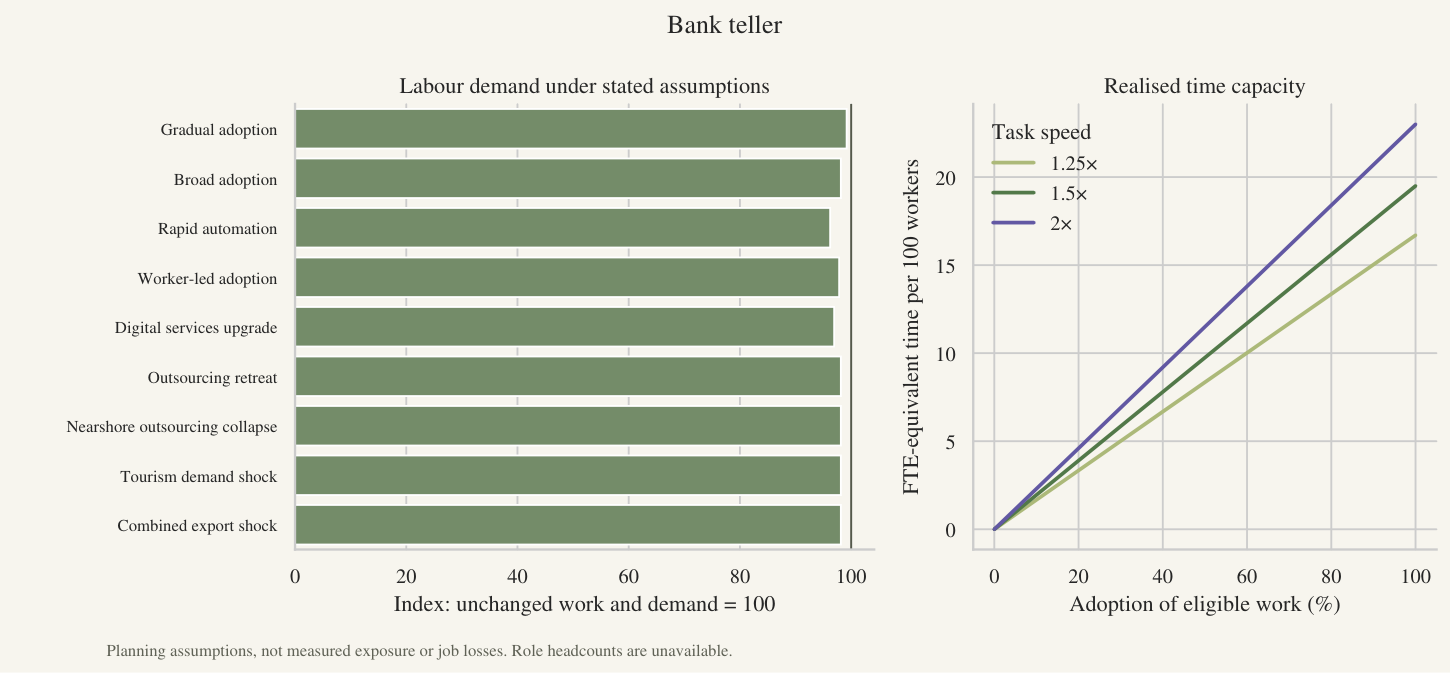
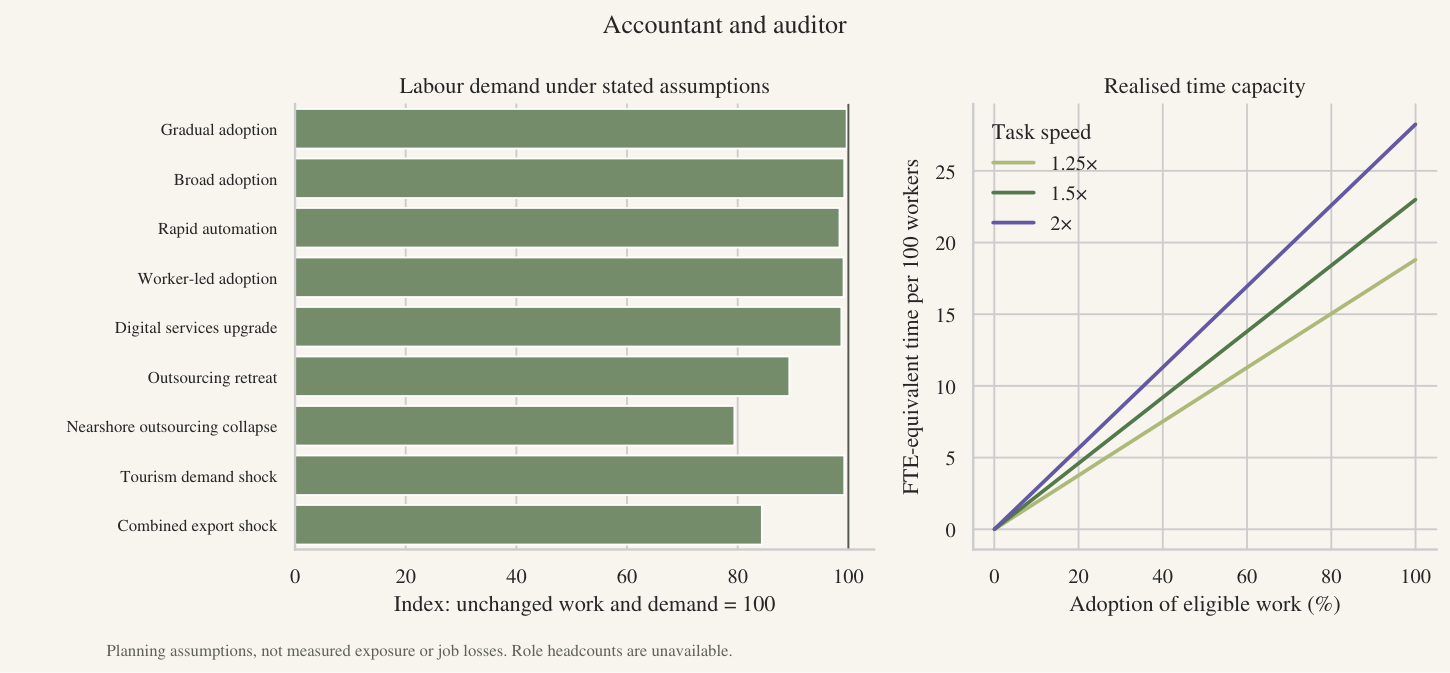
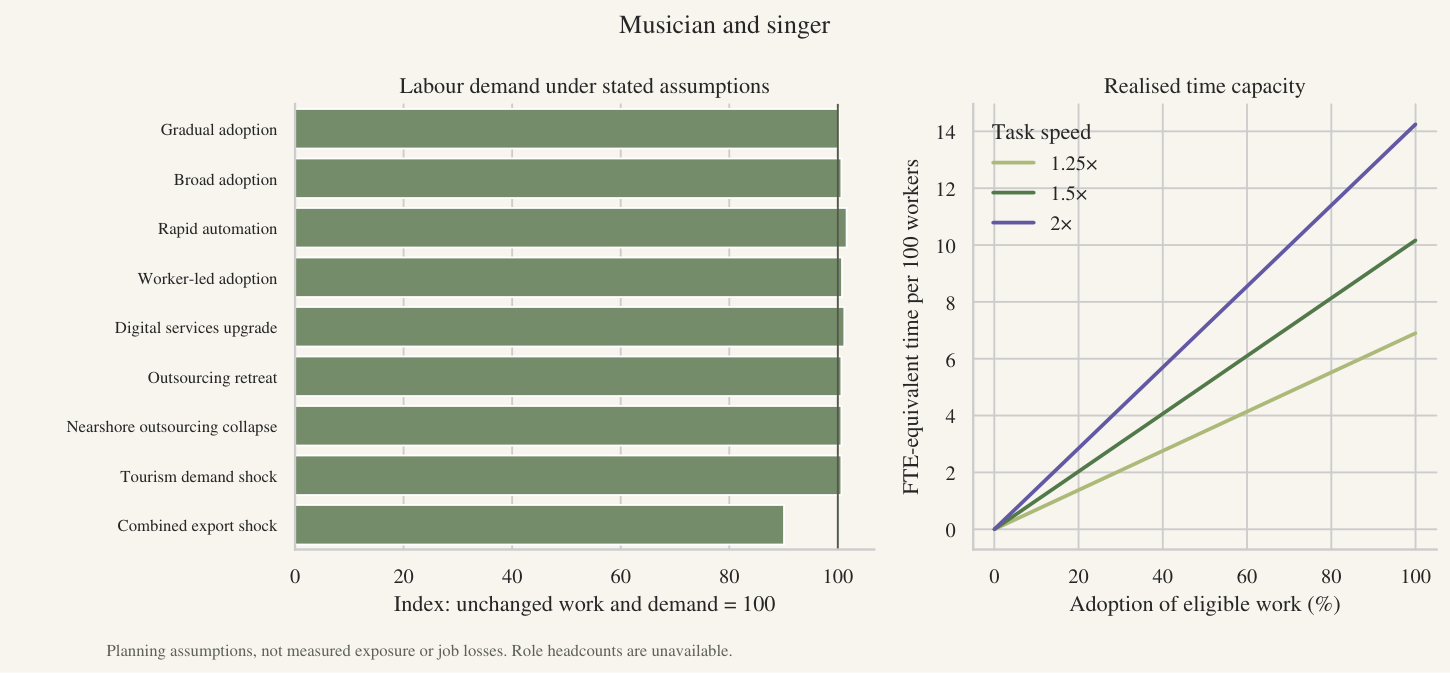
Fi each role A a automation-eligible time share, G augmentation-eligible share, d adoption an s speedup. Gross time capacity per person = d[A + G(1 − 1/s)]. Realised capacity = max[0, 0.70 × gross − 0.05d]. Di 70% factor an oversight deduction assumed. Productivity P = 1/(1 − realised capacity). Capacity measure time per 100 worker under di stated condition, never position eliminated. Di task animation use provisional tag prioritising physical work, care, performance an professional interaction. Dem nuh validated AI rating. Time share assigned separate; counting displayed task nuh determine dem. CAIA new oversight example illustrate possible duty widout proving job creation.
Role · O*NET code · automation time assumption · augmentation time assumption · demand elasticity assumption. No Jamaican headcount available fi any a di 32 role.
Farm manager — 11-9013.00 · 5% · 20% · 0.8
Crop worker — 45-2092.00 · 3% · 10% · 0.8
Production assembler — 51-2092.00 · 8% · 18% · 0.8
Production manager — 11-3051.00 · 15% · 40% · 1.0
Electrician — 47-2111.00 · 5% · 20% · 0.8
Meter reader — 43-5041.00 · 15% · 25% · 0.8
Civil engineer — 17-2051.00 · 15% · 45% · 1.1
Carpenter — 47-2031.00 · 3% · 12% · 0.8
Retail cashier — 41-2011.00 · 30% · 25% · 0.8
Retail salesperson — 41-2031.00 · 15% · 30% · 1.0
Truck driver — 53-3032.00 · 5% · 20% · 0.8
Freight agent — 43-5011.00 · 25% · 40% · 1.0
Hotel receptionist — 43-4081.00 · 25% · 35% · 1.1
Chef — 35-1011.00 · 5% · 20% · 0.9
Tour guide — 39-7011.00 · 10% · 30% · 1.1
Software developer — 15-1252.00 · 25% · 50% · 1.2
IT support specialist — 15-1232.00 · 25% · 40% · 1.0
Bank teller — 43-3071.00 · 25% · 30% · 0.7
Loan officer — 13-2072.00 · 20% · 40% · 0.9
Claims adjuster — 13-1031.00 · 20% · 40% · 0.9
Insurance underwriter — 13-2053.00 · 25% · 45% · 0.9
Accountant an auditor — 13-2011.00 · 25% · 45% · 0.9
Bookkeeper — 43-3031.00 · 40% · 35% · 0.7
Lawyer — 23-1011.00 · 15% · 50% · 0.9
Outsourced customer service agent — 43-4051.00 · 35% · 40% · 0.8
Data entry clerk — 43-9021.00 · 50% · 25% · 0.6
Public service operations manager — 11-1021.00 · 15% · 40% · 1.0
Office clerk — 43-9061.00 · 35% · 40% · 0.8
Primary school teacher — 25-2021.00 · 10% · 35% · 1.0
Registered nurse — 29-1141.00 · 10% · 30% · 1.0
Musician an singer — 27-2042.00 · 10% · 35% · 1.2
Graphic designer — 27-1024.00 · 30% · 45% · 0.8
Bank teller an branch service
AI can help wid transaction record, reconciliation an routine message. Cash handling, identity discrepancy an customer weh need extra help still need staff. Track transaction error, outstanding exception an branch access. Separate generative AI effect from ATM an other digital channel. Inna broad case, capacity a 6.0 full-time workload per 100 worker; labour-demand index 98.2, wid 100 meaning unchanged work an demand. It nuh count people. O*NET 43-3071.00.
Accountant an auditor
Invoice processing an first reconciliation can tek less time. Explaining or approving account still need reliable evidence, control an professional judgement. Measure completion time, error an audit quality, keep qualified sign-off an protect client record. Broad case: capacity 7.2 per 100 an demand 99.3. O*NET 13-2011.00.
Bookkeeping an routine finance
Routine posting an preparing account can be candidate fi automation if record reliable. Investigate unusual entry an reconciliation gap. Include accuracy, fraud control an time fi fix entry when estimating saving. Broad case: capacity 9.6 per 100, demand 97.0. O*NET 43-3031.00.
Lawyer an legal service
Research, document review an drafting can change billable time. Client advice, advocacy an responsibility stay wid di lawyer. Check every citation against primary law an protect privileged material. Measure fixed-fee work alongside billable hours. Broad case: capacity 5.4 per 100, demand 99.4. O*NET 23-1011.00.
Outsourced service agent
Assistance can speed up response, but foreign client can automate or move contract. Faster local service nuh guarantee demand. Track renewal, client concentration, paid work an quality together. Judge training by retained job or suitable placement. Broad case: capacity 8.9 per 100, demand 98.2. O*NET 43-4051.00.
Tourism an hotel work
Reservation, translation an guest message can take less time. Complaint an in-person help still need staff. Visitor loss can outweigh saving. Measure booking conversion, guest outcome, staff hours an visitor demand. Accommodation an food nuh cover every tourism-supported job. Broad case: capacity 6.4 per 100, demand 100.7. O*NET 43-4081.00.
Musician an recorded music
Editing an promotion can get cheaper while synthetic recording compete fi licence an streaming income. Track live fee, recording income, publishing, licence an royalty separate. Document voice consent an rights owner. Global revenue projection nuh Jamaica estimate. Broad case: capacity 3.3 per 100, demand 100.7. O*NET 27-2042.00.
Finance an professional service interpretation
Inna banking an insurance separate transaction, customer service, credit decision an assurance. Generative AI overlap wid earlier digital payment an rules automation. Teller decline cyaan automatically trace to AI. Lending an underwriting need quality, bias, escalation an portfolio checks. Contract loss might affect credit risk an demand fi insurance; balance-sheet effect outside model.
Accountant an bookkeeper can serve more client faster while competition press routine fee down. Demand elasticity represent dat response. Audit liability, reliable source document, privacy, fraud control an independence still matter. Di role index nuh estimate fee or licensed accountant count. In law, quicker review an drafting can change billable time. Advocacy, negotiation, advice an responsibility still tek work. Checking invented citation or wrong jurisdiction can use up saving. Measure fixed-fee margin, billable hours, turnaround, error an client outcome locally. Model nuh estimate dem causally.
Music income, rights an competition
Live performance, recording fee, master rights, publishing, licence an platform royalty have different buyer an contract. AI can cut editing an promotion cost while synthetic track compete inna some market. Voice imitation, consent an attribution can affect bargaining an enforcement cost. Performing live different from di recorded music market. [S08; O*NET 27-2042.00; S20] UNESCO 2026 release on projected global pressure pon creator income an platform concentration motivate testing a revenue channel. Wi nuh transfer its global percentage to Jamaica. No representative Jamaican income-mix dataset, no national musician count infer from arts an other service total.
Combined case assume 30% recorded music demand loss an 35% of illustrative musician demand exposed. Direct weighted shock a 10.5% before productivity an price response. Dat 35% nuh measured export share or royalty estimate. Vary exposed share from zero to one an direct shock run 0% to 30% under same contraction. Live fee, licence an ownership can react differently.
A confidential panel of consenting musician could separate live an recorded income, rights ownership, foreign receipt, cost an working time. Test rights documentation, voice consent, licensing help, collective bargaining an direct audience relationship. Cost an effect need evaluation. Dis study nuh estimate return or settle legal status of one work.
Industry scope an priority
Observed industry counts an representative role cover farming, manufacturing, utility, construction, trade, transport, hospitality, ICT, finance, business service, public administration, education, health, arts an other service. Mining an unspecified industry stay inna combined residual. Capital-intensive industry can produce high value added wid fewer people. Employment share nuh rank GDP contribution.
Banking an insurance. Separate routine operation from advice an consequential decision. Measure error, access, approval, fraud outcome, service time an wage.
Tourism an hospitality. Link guest service wid booking an visitor demand. Measure conversion, guest satisfaction, hours, demand an earnings retained.
Global service an nearshoring. Observe client renewal an upgrading alongside automation. Measure contract value, concentration, seat use, service quality an paid placement.
Accounting an law. Track routine fee an professional judgement. Measure verified accuracy, completion time, fee structure, margin an client outcome.
Music an creative work. Separate live income from recording, royalty an licensing. Measure income by channel, ownership, consent, attribution an platform term.
Farming, construction an manufacturing. Assess planning an record without assuming physical automation. Measure quality-adjusted output, downtime, input cost an safety.
Trade, transport an utility. Assess transaction, dispatch an admin work. Measure throughput, exception, service access, hours an quality.
Public service, education an health. Keep accountable professional decision wid validated workflow. Measure quality, error, learning or care outcome, privacy an workload.
First 90-day research programme could recruit employer an worker, measure task time an agree quality before AI help. Stagger or randomise rollout where practical. Follow job switch, pay an retention beyond training; fi exporter record renewal an client location. Account fi tourism recovery, demand, migration, hours an prior digital investment before attributing change to AI. Proposed programme only; no completed experiment or agreed partnership.
Source register an scope
S01. Working paper 2026-02, Sections 2–3 an Appendix A, task-based framework. Full PDF read. S02. Anthropic public task illustration an scenario explorer, web page read.
S03. STATIN public table extracted: Main Indicators, EMP by Industry, Occupation, Formality, INFOR_FOR EMP by Industry an EMP by ISCED. July 2026 wid history back to January 2024. S04. Downloadable workbook read fi historical cross-check to July 2025, not current baseline.
S05. STATIN national accounts methodology, 2008 SNA an JIC 2016; disaggregated historical IO table available at cost, page read. S06. Full table extracted in JMD million: 2023 GDP, compensation, tax, subsidy an mixed income from STATIN annual GDP page. S07. 2007 table read fi historical structure, not current 2026 multiplier.
S08. O*NET occupation an task CSV downloaded an read fi 21 representative US occupation, CC BY 4.0. S09. ILO Gmyrek et al. publication summary read, DOI 10.54394/HETP0387: exposure versus displacement an need fi local microdata. S10. ILO ISCO-08 classification page read fi major group, task definitions an detailed crosswalk need.
S11. World Bank Jamaica digital diagnostic executive summary an contents inspected fi infrastructure, skill, firm an trust. S12. IMF 16 January 2026 release read fi post-Melissa recovery an external finance, not AI impact. S13. MIIC 6 March 2026 release read, more dan 50,000 global digital service worker, policy view not causal evidence. S14. Alan Lujan MIT-licensed Econ-ARK code reviewed an executed.
S17. Acemoglu, DOI 10.3386/w32487, aggregating task saving. S18. Acemoglu an Restrepo, DOI 10.3386/w25684, displacement an reinstatement. S19. Brynjolfsson, Li an Raymond, DOI 10.3386/w31161, workplace productivity tied to one setting, no effect size transferred. Abstract an metadata only fi all three.
S20. UNESCO official 2026 release read fi creative income, licensing an synthetic content competition; no global projection transferred or Jamaican effect size inferred. S21. BOJ balance-of-payments portal inspected fi external data acquisition, no current BPO-only value-added share obtained or sector share calibrated.
Task inventory: O*NET® 31.0 Database, US Department of Labor, Employment and Training Administration. Use under CC BY 4.0. Screening tag an new-task example a author addition. USDOL/ETA never approve, endorse or test dem change.
Suos dem
- S01 · Korinek Jones Sacher Cotter and McCrory Economic Scenarios for Transformative AI (2026)
- S02 · Anthropic Scenarios for our Economic Future (2026)
- S03 · STATIN Labour Force Data Explorer (2026)
- S04 · STATIN Labour Force Tables downloadable workbook (2025)
- S05 · STATIN National Accounts methodology (2026)
- S06 · STATIN GDP by expenditure and income at current prices 2015 to 2023 (2023)
- S07 · STATIN Input Output table 2007 (2007)
- S08 · O NET Resource Center Database 31.0 (2026)
- S09 · ILO Generative AI and Jobs A Refined Global Index of Occupational Exposure (2025)
- S10 · ILO ISCO 08 structure and definitions (2008)
- S11 · World Bank Digital Economy Country Diagnostic Jamaica (2024)
- S12 · IMF Jamaica RFI approval following Hurricane Melissa (2026)
- S13 · MIIC Jamaica global services and AI (2026)
- S14 · Alan Lujan Econ-ARK economic scenarios implementation (2026)
- S17 · Acemoglu The Simple Macroeconomics of AI (2024)
- S18 · Acemoglu and Restrepo Automation and New Tasks (2019)
- S19 · Brynjolfsson Li and Raymond Generative AI at Work (2023)
- S20 · UNESCO Re|Shaping Policies for Creativity (2026) release (2026)
- S21 · Bank of Jamaica Balance of Payments data portal (2026)