
Caribbean AI AssociationCARIBBEAN
AI ASSOCIATION

CAIA ANALYSIS / EAEI

What the EAEI country score measures

EAEI combines internet use, fixed broadband, electricity access and the female-to-male labour-force participation ratio. It describes selected country conditions, not measured AI benefits.

By Adrian Dunkley · 10 November 2026

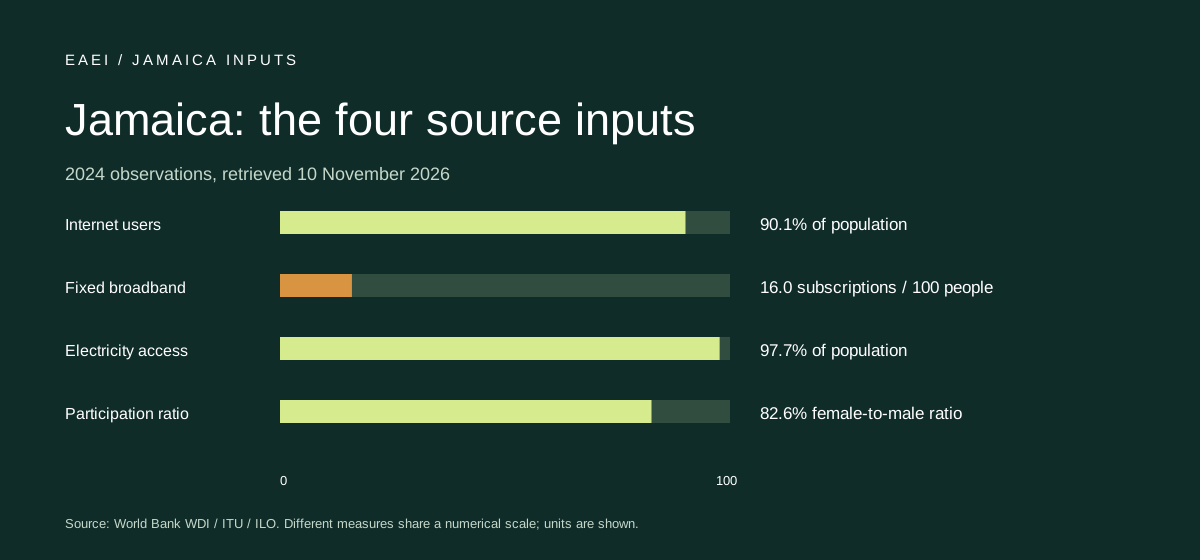
Jamaica 2024: internet use 90.1%, fixed broadband 16.0 subscriptions per 100 people, electricity access 97.7%, participation ratio 82.6%.

What the pilot covers

The study includes fifteen countries. For each required input, the 2024 snapshot uses the latest available value from 2022 through 2024. Eleven countries have complete inputs under this rule. Four receive no overall score because a required input is missing. [api]

The input units change the interpretation

Jamaica’s 2024 internet-use value is 90.1% of the population in the retrieved World Bank series. Its fixed-broadband value is 16.0 subscriptions per 100 people. One measure counts internet users. The other counts subscriptions. Neither directly measures AI use. [internet] [broadband]

EAEI combines internet use and scaled broadband into a digital component. It then combines that component with electricity access and the female-to-male labour-force participation ratio. Jamaica’s default score is 78.5 out of 100. This is a formula output, not the share of people who benefit from AI.

The broadband reference value is a design choice. A business can use mobile connections where fixed broadband is limited. The assessment lets you change the reference value and component weights.

Economic benefits need separate evidence

The IMF AI Preparedness Index examines conditions for adoption. UNESCO RAM examines the capacity to govern AI. EAEI proposes a later test of the link between country conditions, productivity, job quality and the distribution of benefits. The pilot does not establish that link. [imf] [ram]

In one support-agent study, Brynjolfsson, Li and Raymond report that gains “accrue disproportionately to less experienced and lower-skill customer-support workers”. The finding applies to that workplace study. Caribbean employers need task-specific evidence about which workers benefit and what support they need. [work]

Use the components to plan a local study

First, check whether each input represents the local issue. Electricity access does not measure outages. A female-to-male participation ratio near 100% does not establish high participation or equal pay. The overall score cannot resolve these questions.

Jamaica’s score ranges from 65.3 to 91.9 across the 5th–95th percentiles of sampled weight choices. This range shows sensitivity to the weights. It is not a confidence interval.

The next study needs adoption dates, output quality, paid hours, wages and access to training from establishments and workers. These data can test whether the score adds information beyond existing income differences.

Explore the project

Economic AI Elevation Index (EAEI)

Use the assessment or read the full study.

Sources and references

Sources checked on 10 November 2026. The notes state which material CAIA checked and how the study uses it.

  1. World Bank. Indicators API documentation.Version 2 API; query URLs, response dates and hashes retained with the analysis.
  2. World Bank WDI / ITU. Individuals using the Internet (% of population), IT.NET.USER.ZS.API values for 2020–2024; observation years retained per country.
  3. World Bank WDI / ITU. Fixed broadband subscriptions per 100 people, IT.NET.BBND.P2.Subscriptions, not unique people or a percentage of households; 40 is a CAIA normalisation anchor.
  4. International Monetary Fund (2024). AI Preparedness Index, 2023 data edition.Dataset documentation and construct description; comparator only, no IMF scores imported.
  5. UNESCO. AI Readiness Assessment Methodology.What is RAM and how it works; current overview checked 10 November 2026.
  6. Brynjolfsson, E., Li, D., and Raymond, L. (2025). Generative AI at Work. Quarterly Journal of Economics, 140(2), 889–942.Abstract and introduction: staggered deployment, 5,172 support agents, 15% average productivity increase in that setting.

Cite this article

Dunkley, A. (2026). What the EAEI country score measures. Caribbean AI Association. Version 0.1, 10 November 2026. https://caribbeanaiassociation.com/articles/who-can-reach-the-ai-dividend/

Download BibTeX

Use the article title and version in your citation. Credit the original data sources. State any changes that you make. Third-party materials retain their original rights. This page does not claim peer review or provide a DOI.

BibTeX
@misc{dunkley2026eaeiarticle,
  author = {Dunkley, Adrian},
  title = {What the EAEI country score measures},
  year = {2026},
  publisher = {Caribbean AI Association},
  note = {Version 0.1; 10 November 2026},
  url = {https://caribbeanaiassociation.com/articles/who-can-reach-the-ai-dividend/}
}