
Economic scenarios Caribbean
Can AI get us to universal income, for better or worse?
Artificial intelligence could help finance a regular payment to everyone. But higher output does not automatically become public money. Four economic scenarios test what has to happen between a productivity gain and a payment that a Caribbean household can rely on.
Original Caribbean AI Association illustration, created for this analysis. It depicts a distribution mechanism, not a real installation or measured result.
The answer depends on who captures the gains
A regular payment could help households facing job disruption. But a company can become more productive without paying higher wages, creating more local jobs or generating enough additional tax revenue to fund that payment.
Our hypothesis is conditional: AI could make a universal income easier to finance if it creates additional economic value, a country can collect a sustainable share of that value, and its government chooses to distribute it. None of those steps follows automatically from buying better software.
Here, universal basic income means a regular, unconditional cash payment to everyone within a defined eligible population. Guaranteed income may support a selected group rather than everyone. Universal high income is a more ambitious vision of widespread prosperity, not the same promise as a basic payment. A dividend from shared assets is another possible funding arrangement. Better health care and public transport are valuable public services, but they are not cash income. Keeping these choices separate makes a fair comparison possible.
This is a hypothesis check with executed teaching scenarios, not a forecast for Jamaica or the Caribbean. We use an economy with annual output set to 100 and follow the money through wages, profits, taxes and costs. Every numerical input is an explicit illustrative assumption. The downloadable model lets readers reproduce the arithmetic and change those choices.
A larger economy is only the first step
Productivity means producing more value with a given amount of work and other resources. If an AI system helps staff serve more customers accurately, it may raise output. Whether workers, owners, customers or the state receive the benefit depends on wages, competition, ownership, prices and tax collection.
The International Monetary Fund's June 2024 analysis recommends stronger social protection and tax systems able to respond to changes in capital income. That is a policy argument about how to share gains, not evidence that AI already funds a universal payment. IMF, 2024
To avoid counting the same value twice, our model does not add company profits, higher wages and household payments together as separate gains. Wages and profits divide the additional output. Tax receipts finance the public budget. A transfer redistributes resources from that budget; it does not produce the same value a second time.
The same output gain can leave no new dividend
Teaching scenarios, one annual period. Values are percentages of baseline gross domestic product (total economic output), not growth forecasts.
Inclusive gains
See the assumptions behind these scenarios
All settings below are author-selected teaching inputs, not estimates from the cited studies. Adoption is the output-weighted share of activity, not the share of jobs. Tax yield is effective collection, not a statutory rate.
| Input | Inclusive gains | Concentrated returns | Weak gains and disruption | Promise before funding |
|---|---|---|---|---|
| Adopting share of activity | 60.00% | 60.00% | 25.00% | 60.00% |
| Productivity improvement after recurring private costs | 12.00% | 12.00% | 4.00% | 12.00% |
| Output lost in disruption | 0.50% | 0.50% | 1.50% | 0.50% |
| Worker share of added net value | 60.00% | 15.00% | 40.00% | 60.00% |
| Existing wages shifted to profit | 1.00% | 3.00% | 2.00% | 1.00% |
| Effective wage-tax yield | 20.00% | 20.00% | 20.00% | 20.00% |
| Effective capital-tax yield | 25.00% | 5.00% | 15.00% | 25.00% |
| Public implementation and transition spending | 0.40% | 0.60% | 0.60% | 0.40% |
| Administration share of gross payment budget | 5.00% | 5.00% | 5.00% | 5.00% |
Every resident is eligible in these examples, including children. The promise case changes only the proposed payment, to 4% of baseline output. All other inclusive settings stay the same.
Read all values in a static table
| Measure | Inclusive gains | Concentrated returns | Weak gains and disruption | Promise before funding |
|---|---|---|---|---|
| Net output change | 6.70% | 6.70% | -0.50% | 6.70% |
| Additional tax receipts | 1.52% | 0.04% | -0.19% | 1.52% |
| Funded payment | 1.07% | 0.00% | 0.00% | 1.07% |
| Other funding needed before a dividend | 0.00% | 0.56% | 0.79% | 0.00% |
| Promised payment (alternative) | Not specified | Not specified | Not specified | 4.00% |
| Gap if promise paid, including administration | Not specified | Not specified | Not specified | 3.09% |
The same output gain can leave very different public budgets
In the inclusive-gains example, net output rises by 6.70% of the starting economy. Additional tax receipts equal 1.52% of baseline output. After transition spending and payment administration, 1.07% remains for an equal payment to all residents. Each resident receives an amount equal to 1.07% of the economy's average annual output per resident before the change. It is not 1.07% of their own salary. The model does not establish whether that payment would meet basic needs.
In the concentrated-returns example, output rises by the same 6.70%, but workers receive less of the gain, more existing wage income shifts to profits, and the effective collection rate on capital income is lower. Almost no additional tax revenue is collected. Transition spending needs other funding, and there is no new dividend from this funding source. Several assumptions change together: this comparison is not a causal estimate of concentration alone.
In the weak-gains-and-disruption example, the public budget deteriorates. Net output falls by 0.50%, tax receipts decline and transition costs still need to be paid. A universal payment might remain a legitimate policy choice, but it would require another funding source. Calling it an AI dividend would not solve that budget problem.
The final example holds the inclusive economy unchanged but promises a transfer worth 4% of baseline output. Including administration and transition spending, the promise leaves a funding gap of 3.09% of baseline output. It is an alternative payment plan, not an extra payment on top of the smaller funded dividend.
Only part of the output gain reaches residents
Inclusive teaching scenario. Annual amounts as a percentage of baseline gross domestic product (total economic output).
These examples answer a narrow question: what could this assumed funding source support in one year? They do not predict inflation, employment, poverty or economic growth over time. Existing public services, debt obligations and disaster reserves would still have claims on national resources. The model is not a proposal to replace them.
Cash experiments do not settle the AI funding question
Trials tell us something useful about what happens when people receive money. They cannot show whether AI will generate the tax base needed to pay everyone indefinitely.
Finland's 2017–18 experiment involved 2,000 people receiving unemployment benefits. Its official evaluation reported better wellbeing and modest employment effects. It was not a trial across the entire population. The United States OpenResearch study also tested a selected population and found that recipients worked somewhat less. Neither result is a forecast for Caribbean households. Finnish evaluation, 2020 · OpenResearch study
The World Bank's guide explicitly separates what pilots can reveal from system-wide questions about financing and inflation. Those larger questions matter here. A transfer can improve a household's position, but lost wages, higher prices, new taxes or withdrawn benefits can reduce the net improvement. World Bank, 2019
There is also a serious alternative: spend the same resources on targeted income protection or essential services. Organisation for Economic Co-operation and Development research finds that meaningful universal payments can require substantial tax increases. The World Bank guide also warns that spreading a fixed budget more widely can reduce support for those who currently receive it. Universal coverage is a design advantage, not proof that a particular payment is the best use of scarce money. Browne and Immervoll, 2018
Start with a country-level test, not a regional promise
For Caribbean policymakers, the useful next step is a budget and household test in each jurisdiction. Where are the gains earned and taxed? Which workers face lost income? What would reliable payments cost? How much spending would go to imports? What protection and disaster reserves must remain funded?
Jamaica's request for emergency financing after Hurricane Melissa illustrates why the last question matters. An income promise must survive recovery needs as well as good years. The January 2026 financing announcement is evidence of that pressure, not an estimate of money available for an AI-funded payment today. IMF, 16 January 2026
Governments, employers and researchers can start with three tests:
- Measure additional value before allocating it. Employers and researchers should compare real deployments with a credible baseline, including software, supervision, errors and training costs. Hours saved are not automatically new taxable output.
- Test the budget under weak results. Finance ministries should show collectible revenue, administration, transition support and a funding gap. Compare a universal payment with targeted support and public services using the same resources.
- Check what households actually keep. An independently evaluated pilot should examine income after taxes, lost benefits and price changes, alongside work, wellbeing and access. Publish the eligibility rules and do not treat a successful pilot as proof of national affordability.
AI may strengthen the economic case for income security. It may also concentrate gains while leaving workers and governments to absorb the disruption. Before promising a payment, governments need evidence of additional taxable value, a credible collection plan and a budget that still works when gains disappoint.
Methods and reproducibility
The scenarios use one annual accounting period, constant baseline purchasing-power units and a fixed population. They are deterministic calculations, not Monte Carlo probabilities or confidence intervals. All residents, including children, receive an equal share in the teaching model. No national currency, poverty threshold or inflation rate is inferred. Source research informs the questions; it does not supply the model's numerical assumptions. The model, inputs, tests and detailed notes are available below.
AI assisted with research, drafting, coding and review. The simulations are reproducible illustrative calculations, not reported economic outcomes.
Inspect and reproduce the model
Start with the assumptions and methods, then run the Python model to reproduce the results. No private data or paid software is needed.
View the accounting equations
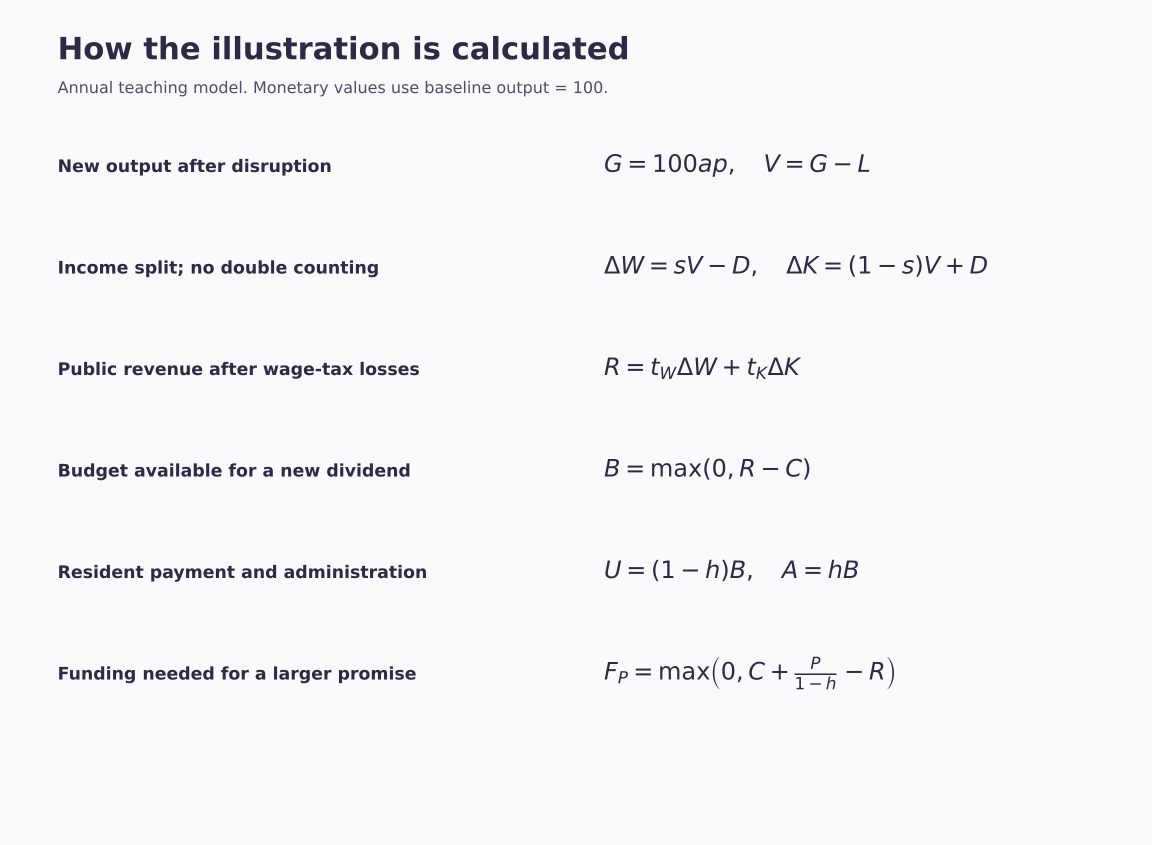
Scroll horizontally on small screens, or open the full-size equations. Equations are typeset from the accompanying mathematical source. The methods file defines each symbol. The model is an illustrative annual accounting exercise, not a forecast.
Independent Caribbean analysis from the Caribbean AI Association. More analysis · Join the association